
Table of Contents
Date: July 1, 2026, Category: Blog, Financial Strategy
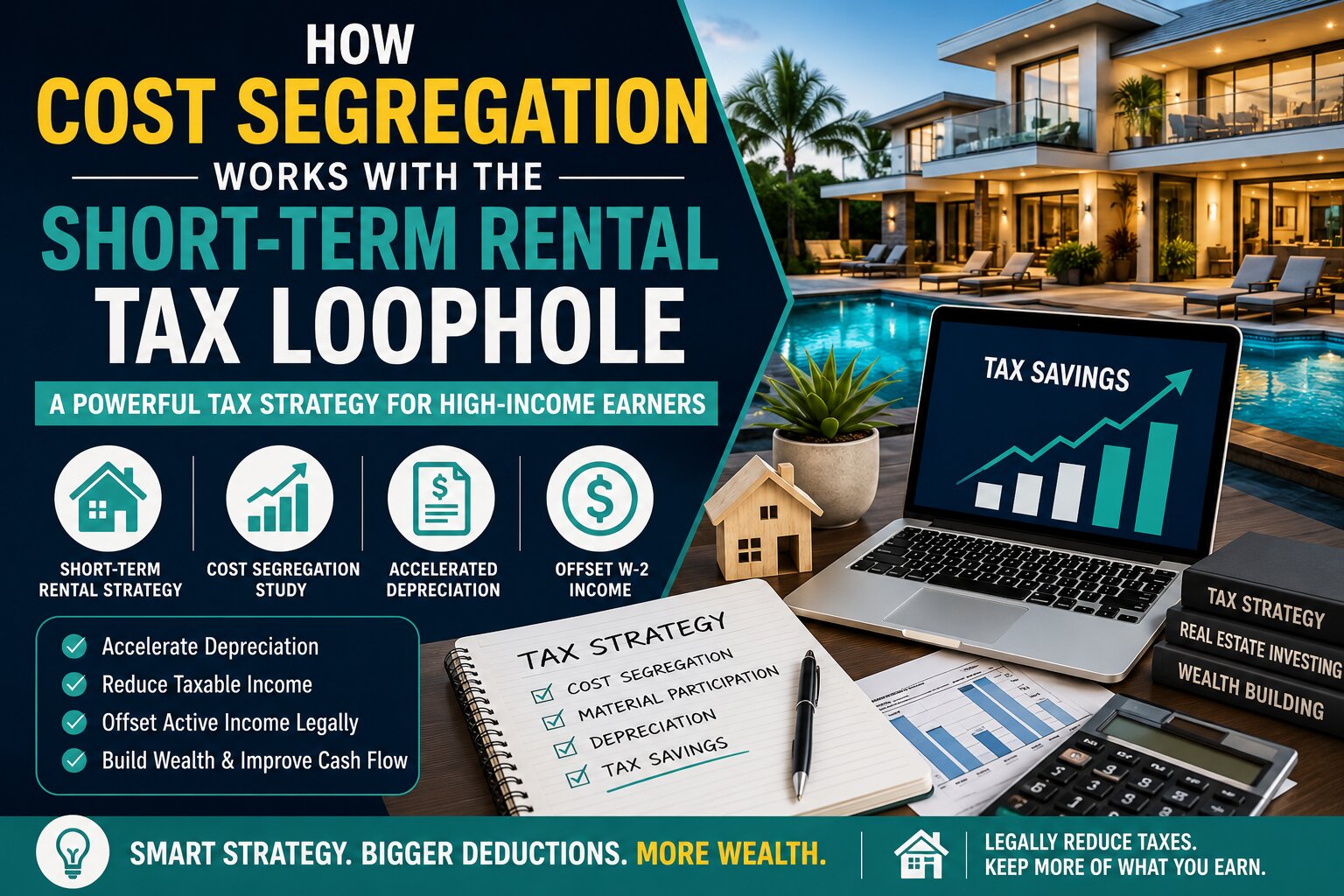
If you’re a high-income earner paying a significant amount in federal taxes each year, you’ve probably wondered whether there is a legal way to reduce your tax burden without relying on risky tax shelters. The good news is that there is a proven strategy many real estate investors use to potentially save tens or even hundreds of thousands of dollars in taxes: Cost Segregation combined with the Short-Term Rental (STR) Tax Loophole.
When these two strategies are used correctly, they can create substantial depreciation deductions that may offset active income. However, the rules are complex, and proper planning is essential to maximize benefits while remaining IRS compliant.
In this guide, we’ll explain how Cost Segregation works with the Short-Term Rental Tax Loophole, who qualifies, and why this STR tax strategy has become one of the most valuable tax planning opportunities for high-income earners in the United States.
Cost Segregation is a tax planning strategy that accelerates depreciation deductions on investment real estate.
Normally, residential rental properties are depreciated over 27.5 years, while commercial properties are depreciated over 39 years. A cost segregation study identifies components of a property such as flooring, lighting, landscaping, appliances, cabinetry, and other personal property that qualify for shorter depreciation lives of 5, 7, or 15 years.
Instead of waiting decades to recover these costs, property owners can claim significantly larger deductions during the early years of ownership.
Accelerating depreciation improves cash flow by reducing taxable income sooner rather than later.
The Short-Term Rental Tax Loophole allows certain vacation rental owners to use rental losses to offset active income without qualifying as a Real Estate Professional.
Normally, rental losses are considered passive and cannot reduce W-2 wages or business income.
However, short-term rentals are treated differently when:
When these requirements are met, the activity may avoid the passive activity rules that typically limit rental loss deductions.
This creates an opportunity for high-income professionals such as:
The real power comes from combining Cost Segregation with the STR Tax Loophole.
Here’s how the process generally works.
Acquire an investment property intended for short-term rental use through platforms like Airbnb or Vrbo.
The owner must materially participate in operating the property under IRS rules.
Common tests include:
Proper documentation is critical.
A qualified engineering-based cost segregation study identifies assets eligible for accelerated depreciation.
Instead of depreciating everything over 27.5 years, many components receive shorter recovery periods.
Accelerated depreciation creates larger deductions in the current tax year.
Combined with available bonus depreciation under current tax law, eligible assets may generate significant first-year deductions.
Because qualifying short-term rentals may not be treated as passive activities, depreciation losses may offset:
This is where substantial tax savings often occur.
Imagine a physician purchases a short-term rental property for $1,000,000.
After allocating land value and completing a cost segregation study, approximately 25% of the depreciable basis qualifies for accelerated depreciation.
Instead of receiving only standard annual depreciation, the owner may be able to claim substantially larger deductions during the first year, depending on current bonus depreciation rules and their individual tax situation.
If the owner also satisfies the material participation requirements, those deductions may offset active income and significantly reduce their overall tax liability.
Every situation is different, which is why professional tax planning is essential.
Accelerated depreciation can dramatically reduce taxable income.
Lower taxes leave more capital available for:
Receiving tax benefits earlier improves investment performance compared to waiting decades for standard depreciation.
Many investors reinvest tax savings into acquiring additional income-producing properties.
This strategy is particularly valuable for:
Individuals in higher tax brackets generally experience the greatest potential tax savings.
Not every rental property meets the requirements for the STR Tax Loophole.
Without adequate participation records, deductions could be challenged.
Keep detailed logs of:
A quality engineering-based study provides stronger support than estimating asset classifications independently.
Tax laws change frequently. Strategic timing can affect available depreciation benefits.
Many investors assume a cost segregation study must be completed immediately after purchase.
In reality, previously purchased properties may still qualify for a “look-back” study, allowing owners to catch up on missed depreciation without amending prior tax returns in many cases.
For many short-term rental owners, the answer is yes.
A cost segregation study often pays for itself when the property has sufficient value and qualifying assets. The larger the property and the higher the owner’s tax bracket, the greater the potential benefit.
However, every investor’s financial picture is unique.
Before implementing this strategy, consider:
Working with experienced tax professionals helps ensure the strategy aligns with your overall tax plan.
For high-income earners looking to legally reduce taxes, combining Cost Segregation with the Short-Term Rental Tax Loophole can be one of the most powerful tax strategies available.
When executed properly, this approach may accelerate depreciation, improve cash flow, and create significant tax deductions that can offset active income. Because the IRS rules surrounding depreciation, material participation, and short-term rentals are highly technical, careful planning and accurate documentation are essential.
Whether you’re purchasing your first vacation rental or expanding an existing portfolio, understanding how these strategies work together can help you make smarter financial decisions and maximize the after-tax return on your real estate investments.
If you’re a high-income earner considering a short-term rental investment or wondering whether your current property qualifies, the experienced team at Short Term Rentals CPA can help.
Our specialists provide comprehensive tax planning, cost segregation guidance, material participation analysis, and year-round strategies designed specifically for short-term rental investors.
Schedule a consultation today to discover how Cost Segregation and the Short-Term Rental Tax Loophole could help you reduce your tax liability, increase cash flow, and build long-term wealth—while staying fully compliant with IRS regulations.
Cost Segregation is a tax planning strategy that accelerates depreciation deductions by identifying building components that qualify for shorter depreciation periods. Instead of depreciating an entire residential rental property over 27.5 years, certain assets can be depreciated over 5, 7, or 15 years, allowing property owners to claim larger deductions earlier.
The Short-Term Rental (STR) Tax Loophole allows qualifying short-term rental owners to potentially use rental losses to offset active income, such as W-2 wages or business income, without meeting the requirements for Real Estate Professional Status. To qualify, the property generally must have an average guest stay of seven days or less, and the owner must materially participate in managing the rental.
This strategy is especially beneficial for high-income earners, including physicians, dentists, attorneys, executives, business owners, engineers, and other professionals who have significant taxable income and own or plan to purchase short-term rental properties.
While not legally required, a professional engineering-based Cost Segregation study is highly recommended. It provides detailed documentation supporting accelerated depreciation claims and helps ensure compliance with IRS guidelines while maximizing available deductions.
Yes. In many cases, property owners can complete a “look-back” Cost Segregation study on previously purchased properties. This allows them to catch up on missed depreciation deductions without necessarily amending prior tax returns, depending on their circumstances.
The rules governing Cost Segregation, material participation, bonus depreciation, and the Short-Term Rental Tax Loophole are complex and frequently change. An experienced CPA can help determine eligibility, maximize tax savings, maintain proper documentation, and ensure your tax strategy remains fully compliant with IRS regulations.
Short Term Rentals CPA provides premier tax engineering and STR loophole strategies to help high-income professionals legally offset W-2 income.
©2026.Short Term Rentals CPA. All Rights Reserved.