
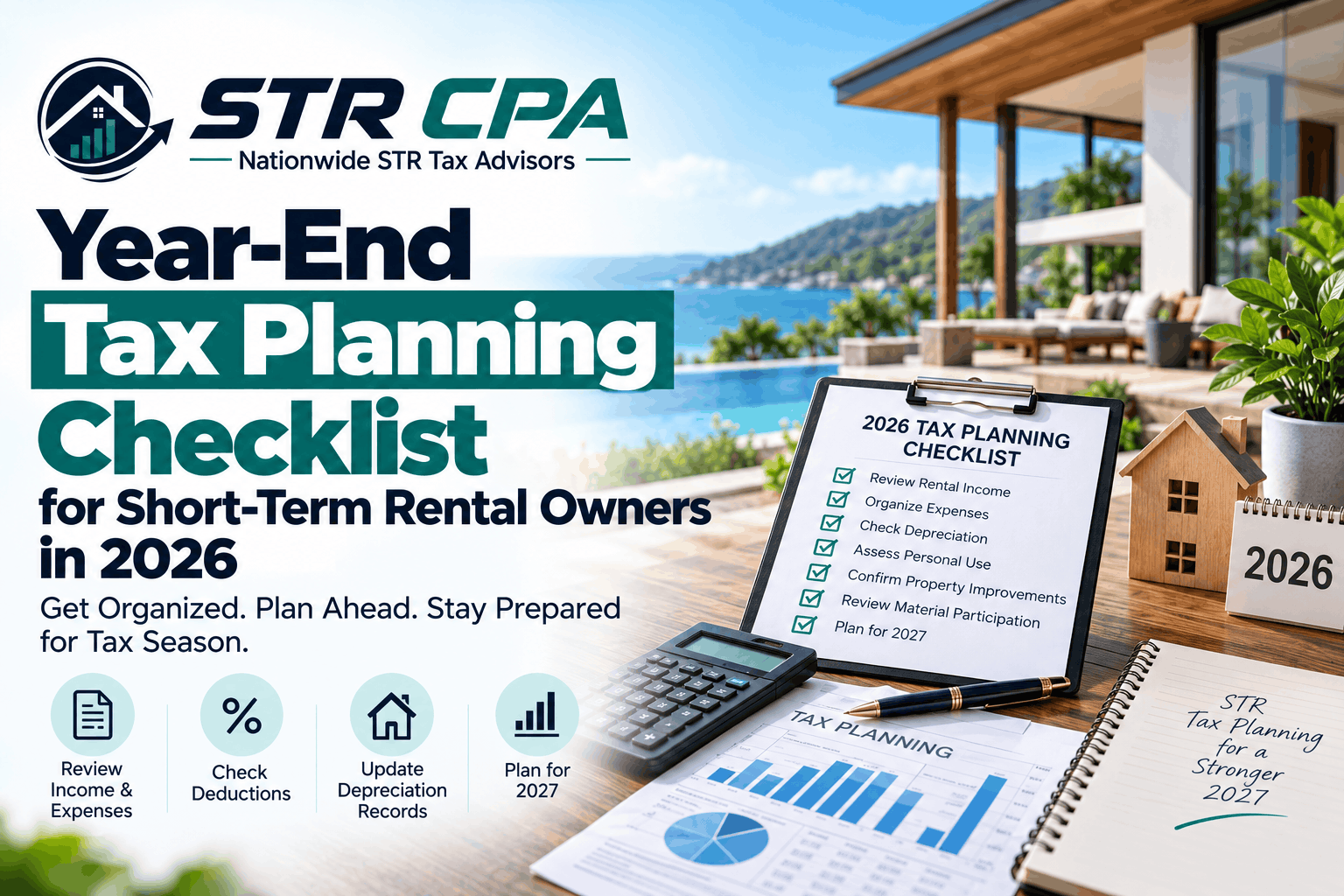
As 2026 comes to an end, Airbnb hosts and vacation rental investors have an opportunity to review their finances before tax season begins. Waiting until January to organize expenses, check depreciation records, or review property activity can make tax preparation more difficult than necessary.
Year-end tax planning for short-term rentals involves more than finding deductions. It means understanding how your property performed, whether expenses were recorded correctly, and how your rental activity may affect your tax return.
Whether you own one Airbnb or manage several vacation rentals, this checklist covers important items to review before December 31, 2026.
1. Review Your Airbnb Income and Expenses
Start by reviewing your rental income for the year. Compare booking reports from Airbnb, Vrbo, and other platforms with your bank deposits and accounting records.
Remember that platform deposits may reflect amounts after service fees or other adjustments. Your bookkeeping should properly account for rental revenue, fees, refunds, and other transactions.
Next, review operating expenses such as cleaning, maintenance, utilities, insurance, supplies, property management, and professional services.
For additional guidance, read our guide to 25 short-term rental tax deductions.
2. Check Repairs and Property Improvements
Did you replace an appliance, renovate a bathroom, repair a roof, or upgrade furniture during 2026?
These purchases may have different tax treatments. Routine repairs can sometimes be deducted as operating expenses, while significant improvements may need to be capitalized and depreciated.
Review contractor invoices and purchase records before categorizing these costs. Correct classification helps maintain accurate depreciation schedules and property records.
3. Review Depreciation and Bonus Depreciation
Depreciation is an important part of short-term rental tax planning. It generally allows owners to recover the cost of qualifying rental property over applicable recovery periods.
Under federal law applicable in 2026, eligible property acquired after January 19, 2025, may qualify for 100% bonus depreciation when the applicable requirements are satisfied.
However, this does not mean an entire Airbnb property purchase automatically qualifies for immediate deduction. Buildings, land, furniture, appliances, and certain improvements can have different tax treatments.
Owners should review acquisition dates, placed-in-service dates, asset classifications, and existing depreciation schedules with their tax professional.
4. Consider Whether Cost Segregation Is Appropriate
Some short-term rental investors may benefit from reviewing whether a cost segregation study is appropriate for their property.
Cost segregation identifies qualifying property components that may be depreciated over shorter periods than the building itself. Depending on the property’s characteristics and applicable rules, this may accelerate certain depreciation deductions.
However, a cost segregation study is not necessary or beneficial for every property. The property’s value, eligible assets, cost of the study, ownership plans, and tax circumstances should all be considered.
Learn more about how cost segregation fits into short-term rental tax planning.
5. Organize Your Material Participation Records
If you are evaluating whether losses from your short-term rental may be treated as nonpassive, your involvement in the activity deserves careful attention.
Material participation is determined under specific IRS rules. Depending on the circumstances, time spent managing bookings, communicating with guests, performing maintenance, or handling operations may be relevant.
Maintain records showing the dates, activities performed, and time spent. Remember that not every hour associated with owning an investment property necessarily counts toward material participation.
Read our short-term rental material participation guide for additional information.
6. Confirm When New Property Was Placed in Service
Buying a vacation rental before December 31 does not automatically mean the property qualifies for depreciation deductions that year.
Generally, depreciation begins when property is ready and available for its intended rental use, rather than simply when the purchase closes.
For example, if you purchase a cabin in November but renovations prevent it from being ready for rental use until January 2027, the placed-in-service date may fall in 2027.
Keep documentation showing when the property became ready and available, including listing records, inspection documents, and other relevant evidence.
7. Review Personal Use of Your Vacation Rental
If you or your family used the rental property personally during 2026, review those dates before preparing your tax return.
Personal use may affect how expenses are allocated and whether certain rental loss limitations apply. A property used exclusively for rental purposes can have a different tax treatment from a vacation home used for both rental and personal stays.
For additional guidance, refer to IRS Publication 527: Residential Rental Property.
8. Review How Your Rental Income Is Reported
Not every Airbnb activity is reported in exactly the same way. The appropriate tax reporting depends on the nature of the rental activity and the services provided to guests.
Some rental activities are generally reported on Schedule E, while activities involving substantial services may require different reporting.
Before year-end, review how your property operates and whether its reporting treatment remains appropriate.
For more information, see our guide to taxes on Airbnb income.
9. Evaluate Potential Rental Losses
A short-term rental may show a tax loss because of operating expenses, depreciation, or other allowable deductions. However, a tax loss does not automatically reduce income from employment or other sources.
The treatment of losses depends on factors such as the activity’s classification, material participation, passive activity rules, basis, and at-risk limitations.
Owners considering accelerated depreciation should review the complete tax picture before assuming a particular deduction will reduce their overall tax liability.
10. Prepare Your Records for Tax Season
One of the most useful year-end steps is organizing your documents before your CPA begins preparing your return.
Gather your booking statements, bank records, mortgage statements, property tax bills, insurance documents, contractor invoices, and depreciation schedules.
If you own multiple properties, keep separate income and expense records for each location. This helps your accountant review individual property performance and identify transactions that require additional attention.
11. Plan for 2027 Before the Year Ends
Year-end planning should also consider what comes next. If you intend to purchase another rental, renovate an existing property, change management arrangements, or sell an investment, those decisions may have tax consequences.
Reviewing upcoming plans with your tax advisor can help you understand how depreciation, ownership structure, operating expenses, and potential property sales may affect future returns.
Short-term rental tax planning is most useful when it considers both current-year reporting and longer-term investment goals.
Final Thoughts
Completing a 2026 short-term rental tax checklist can help Airbnb hosts enter tax season with better records and a clearer understanding of their rental activity.
Reviewing income, expenses, depreciation, personal use, material participation, and property improvements before December 31 can also reveal issues that may be harder to address after the year closes.
Every rental property is different. The appropriate tax approach depends on how the property is used, the owner’s involvement, and the broader financial circumstances.