
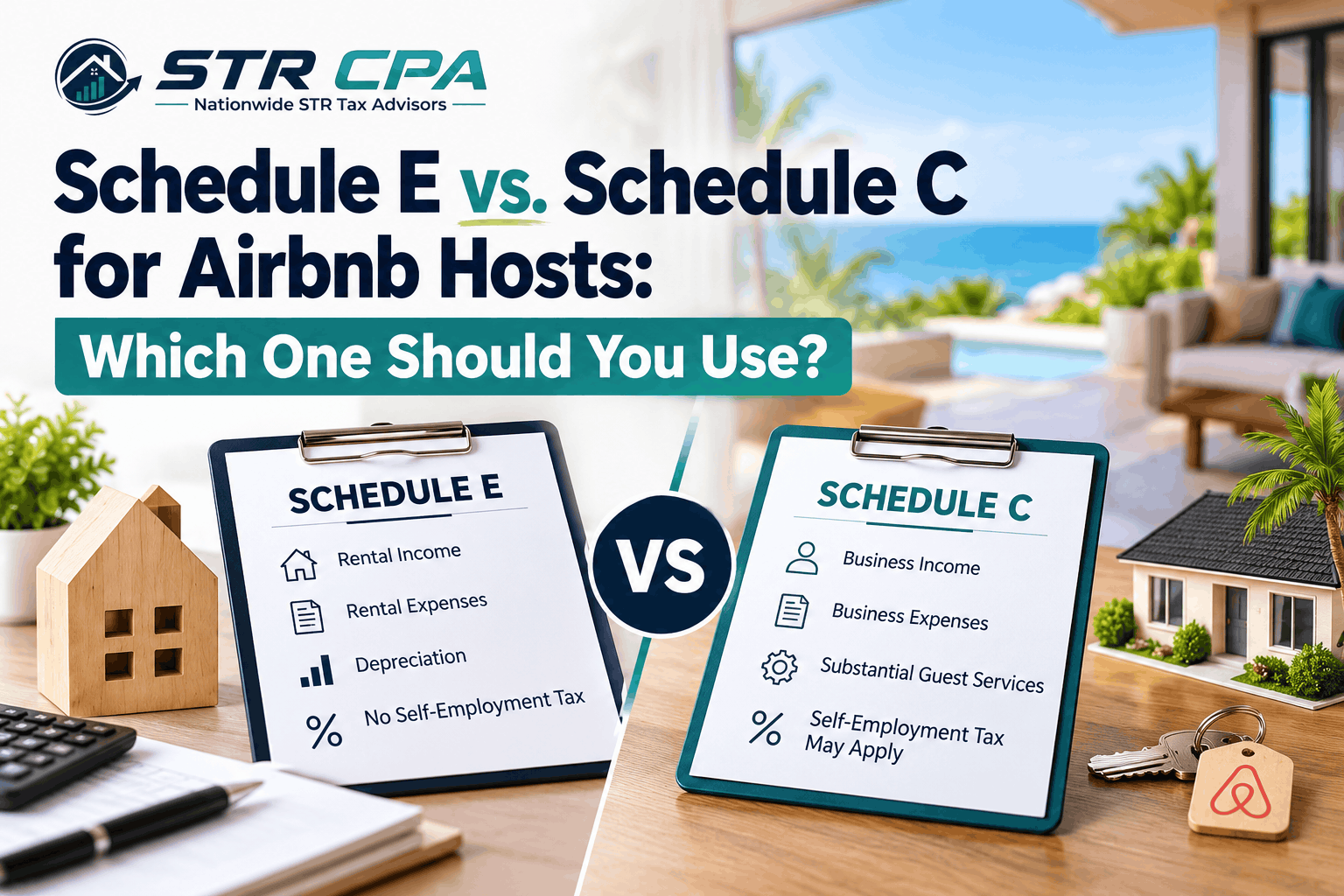
If you earn income from Airbnb, Vrbo, or another short-term rental platform, you may wonder how to report that income on your federal tax return. One common question is whether Airbnb income belongs on Schedule E or Schedule C. Both forms report income and expenses, but they apply to different types of activities and can affect how your income is taxed.
For many Airbnb hosts, Schedule E is the appropriate form because the income comes primarily from renting property. However, hosts who provide substantial services to guests may need to report their activity on Schedule C instead. The distinction is important because it can affect self-employment taxes, expense reporting, and how your rental activity is classified.
This guide explains the differences between Schedule E and Schedule C for Airbnb hosts, how the IRS evaluates guest services, what happens with short-term rental losses, and what records you should keep before filing your taxes.
What Is Schedule E for Airbnb Hosts?
Schedule E (Form 1040) is generally used to report income and expenses from rental real estate. If you own a vacation rental and primarily provide guests with a place to stay, your rental income will often be reported on Schedule E.
For example, suppose you own a two-bedroom vacation property that you list on Airbnb. Guests book the property for several nights, and you provide basic amenities such as furniture, internet access, utilities, clean linens at check-in, and cleaning between reservations. You do not offer daily housekeeping or other substantial services during their stays.
In this situation, the activity will generally resemble a rental real estate operation rather than a hospitality business providing significant guest services. Schedule E may therefore be appropriate.
Common expenses reported on Schedule E
Airbnb hosts using Schedule E may generally deduct qualifying rental expenses, subject to applicable tax rules. Common examples include:
- Mortgage interest attributable to the rental property
- Property taxes
- Rental property insurance
- Utilities and internet expenses
- Cleaning and maintenance costs
- Property management fees
- Airbnb and other booking platform fees
- Repairs and routine maintenance
- Guest supplies and replacement linens
- Allowable depreciation on buildings and equipment
Some costs must be capitalized or depreciated rather than deducted immediately. Personal use of the property may also require expenses to be allocated between rental and personal use.
For a more detailed explanation of qualifying expenses, read our guide to 25 short-term rental tax deductions.
What Is Schedule C for Airbnb Hosts?
Schedule C (Form 1040) is used to report income and expenses from a sole proprietorship or certain other business activities. For Airbnb hosts, Schedule C generally becomes relevant when the owner provides substantial services primarily for the convenience of guests, making the activity more like operating a hotel or bed-and-breakfast business.
The IRS distinguishes between simply providing accommodation and offering significant services as part of the guest experience.
For example, imagine an Airbnb owner who operates several furnished units and provides daily housekeeping, breakfast service, and additional guest assistance throughout each reservation. If those services are substantial and primarily benefit the guests, the activity may be reportable on Schedule C.
However, offering a furnished property, providing Wi-Fi, or arranging cleaning between reservations does not automatically mean a host must use Schedule C.
Services that may affect Schedule C classification
The following services may be relevant when determining whether an Airbnb activity involves substantial services:
- Regular housekeeping during a guest’s stay
- Meal preparation or breakfast service
- Hotel-style guest services
- Regular personal services provided as part of the accommodation
- Other substantial services primarily benefiting guests
No single service automatically determines the correct form. The nature, frequency, and significance of the services must be evaluated together.
Schedule E vs. Schedule C: Key Differences
Although both schedules allow eligible income and expenses to be reported, they have different tax implications.
| Factor | Schedule E | Schedule C |
|---|---|---|
| Typical activity | Rental real estate | Business providing substantial guest services |
| Guest services | Basic rental-related services | Significant services primarily for guest convenience |
| Self-employment tax | Generally not applicable to rental income | Generally applicable to qualifying net business earnings |
| Expense deductions | Eligible rental expenses | Eligible business expenses |
| Passive activity rules | Depend on activity classification and participation | Depend on activity classification and participation |
The correct schedule is based on the actual operation of your property. Hosts should not select a form simply because one appears to offer a lower tax bill.
Does Airbnb Income Have to Be Reported on Schedule C if Guests Stay Less Than Seven Days?
No. This is an important distinction because two different sets of IRS rules are often confused.
Under the passive activity regulations, an activity with an average customer use of seven days or less may not be treated as a rental activity for purposes of those rules. Certain activities with longer average stays and significant personal services may also qualify for exceptions.
However, these passive activity classifications do not automatically determine whether income should be reported on Schedule E or Schedule C.
An Airbnb property with an average guest stay of four nights may still belong on Schedule E if the owner does not provide substantial services to guests.
Similarly, a property may be treated as a non-rental activity for passive activity purposes without automatically becoming subject to self-employment tax.
Understanding this distinction is particularly important for investors considering short-term rental tax strategies involving material participation.
Does Schedule C Mean Airbnb Hosts Pay Self-Employment Tax?
Self-employment tax is one of the most important differences between the two reporting methods.
Rental income reported on Schedule E is generally excluded from net earnings from self-employment, subject to exceptions. By contrast, when an Airbnb operation constitutes a business providing substantial services to guests, qualifying net earnings reported on Schedule C are generally subject to self-employment tax.
The standard combined Social Security and Medicare self-employment tax rate is 15.3%, although the actual calculation depends on applicable thresholds, limits, and adjustments.
Example: How reporting can affect taxes
Suppose two Airbnb owners each earn $60,000 in gross rental revenue and have $35,000 in allowable expenses, leaving $25,000 before considering any additional tax adjustments.
The first owner provides accommodation and basic rental-related services. The activity may be reported on Schedule E, and the rental income generally would not be subject to self-employment tax.
The second owner provides substantial hotel-style services to guests. If the activity qualifies as a business subject to self-employment tax, the net earnings may be subject to additional Social Security and Medicare taxes.
Both owners still need to consider federal income taxes, depreciation, deductions, and other applicable rules. The example illustrates why the services provided matter more than the fact that both properties are advertised on Airbnb.
Can Airbnb Hosts Deduct Rental Losses Against W-2 Income?
Some short-term rental investors purchase properties partly because of the potential tax benefits associated with depreciation and operating expenses. However, the ability to use losses against W-2 wages or other nonpassive income is not determined solely by whether the activity appears on Schedule E or Schedule C.
Rental real estate activities are generally passive under the IRS passive activity rules, although exceptions and special rules may apply.
When a short-term rental activity meets an exception to the rental-activity definition, material participation becomes an important consideration. If the owner satisfies an applicable material participation test, losses may potentially be treated as nonpassive, subject to other limitations.
For example, an owner who personally manages guest communications, coordinates operations, handles bookings, and performs other qualifying activities may be able to establish material participation, depending on the time spent and the applicable tests.
However, the IRS requires more than simply stating that you actively manage an Airbnb. Owners should maintain reasonable documentation of their participation.
Read our short-term rental material participation guide to understand how the participation tests work.
How Depreciation Affects Airbnb Tax Reporting
Depreciation can significantly affect the taxable income reported from an Airbnb property. Unlike routine operating expenses, the cost of a rental building and many improvements is generally recovered over applicable depreciation periods.
Furniture, appliances, and certain other assets may qualify for different recovery periods. In some situations, a cost segregation study can help identify components eligible for shorter depreciation treatment.
Depreciation deductions may be available whether the rental activity is reported on Schedule E or Schedule C, provided the relevant requirements are satisfied.
However, a depreciation deduction does not automatically create an immediately usable tax loss. Passive activity limitations, basis limitations, at-risk rules, and other tax provisions can affect the deduction’s current-year benefit.
For a broader explanation of Airbnb depreciation and tax reporting, see our complete Airbnb tax guide.
What Records Should Airbnb Hosts Keep for Tax Filing?
Whether your Airbnb income is reported on Schedule E or Schedule C, organized financial records make tax preparation more accurate and help support the amounts reported.
Start by maintaining records of rental revenue, booking platform statements, guest payments, refunds, cleaning fees, and other income received during the year.
Expense records should include invoices, receipts, bank statements, insurance payments, property taxes, mortgage interest statements, repair costs, utilities, and property management fees.
Owners should also maintain a depreciation schedule showing the purchase price, land allocation, improvements, furniture, equipment, and prior depreciation deductions.
If you use the property personally, keep a calendar identifying rental days, personal-use days, and other relevant periods. If you are relying on material participation, maintain records describing your work and the time spent on qualifying activities.
For additional context about reporting income and estimating tax obligations, read how much tax you pay on Airbnb income.
Common Tax Filing Mistakes Airbnb Hosts Should Avoid
Assuming every Airbnb belongs on Schedule C
Simply operating a short-term rental does not automatically make the activity a Schedule C business. The services provided to guests are a key consideration.
Assuming short guest stays determine the filing schedule
The average length of guest stays is important for certain passive activity rules, but it does not independently determine the correct income reporting form.
Ignoring self-employment tax implications
Hosts who provide substantial guest services should evaluate whether their activity generates earnings subject to self-employment tax.
Mixing personal and rental expenses
Using a vacation property for both personal stays and rental activity can affect deductions. Owners should track personal-use and rental-use days carefully.
Failing to maintain depreciation records
Depreciation calculations may affect multiple tax years, including the year the property is sold. Accurate records help avoid duplicated or missed deductions.
Assuming Schedule C automatically makes losses deductible
Reporting an activity on Schedule C does not eliminate passive activity, basis, at-risk, or other loss limitations. The activity must be analyzed under the relevant rules.
How to Determine the Right Tax Schedule for Your Airbnb
Before filing your tax return, review how your short-term rental actually operates. Consider whether you primarily provide accommodation or offer substantial additional services during guest stays.
You should also review your average guest stay, property usage, ownership structure, personal involvement, and available expense records. These details can affect both the appropriate reporting schedule and other tax calculations.
If you own multiple properties, the activities may not all have identical tax treatment. A property operated as a traditional vacation rental may have different reporting requirements from a property operated with substantial hospitality services.
For owners with significant rental income, substantial depreciation deductions, or multiple properties, having a CPA review the facts before filing can help reduce reporting errors and identify relevant planning considerations.
Need Help Filing Your Airbnb Taxes?
Choosing between Schedule E and Schedule C is just one part of short-term rental tax reporting. Your guest services, rental expenses, depreciation, and participation in the property can all affect your tax return.
ShortTermRentalsCPA helps Airbnb hosts and vacation rental investors understand their reporting obligations, organize financial records, and evaluate tax planning opportunities based on their circumstances.