
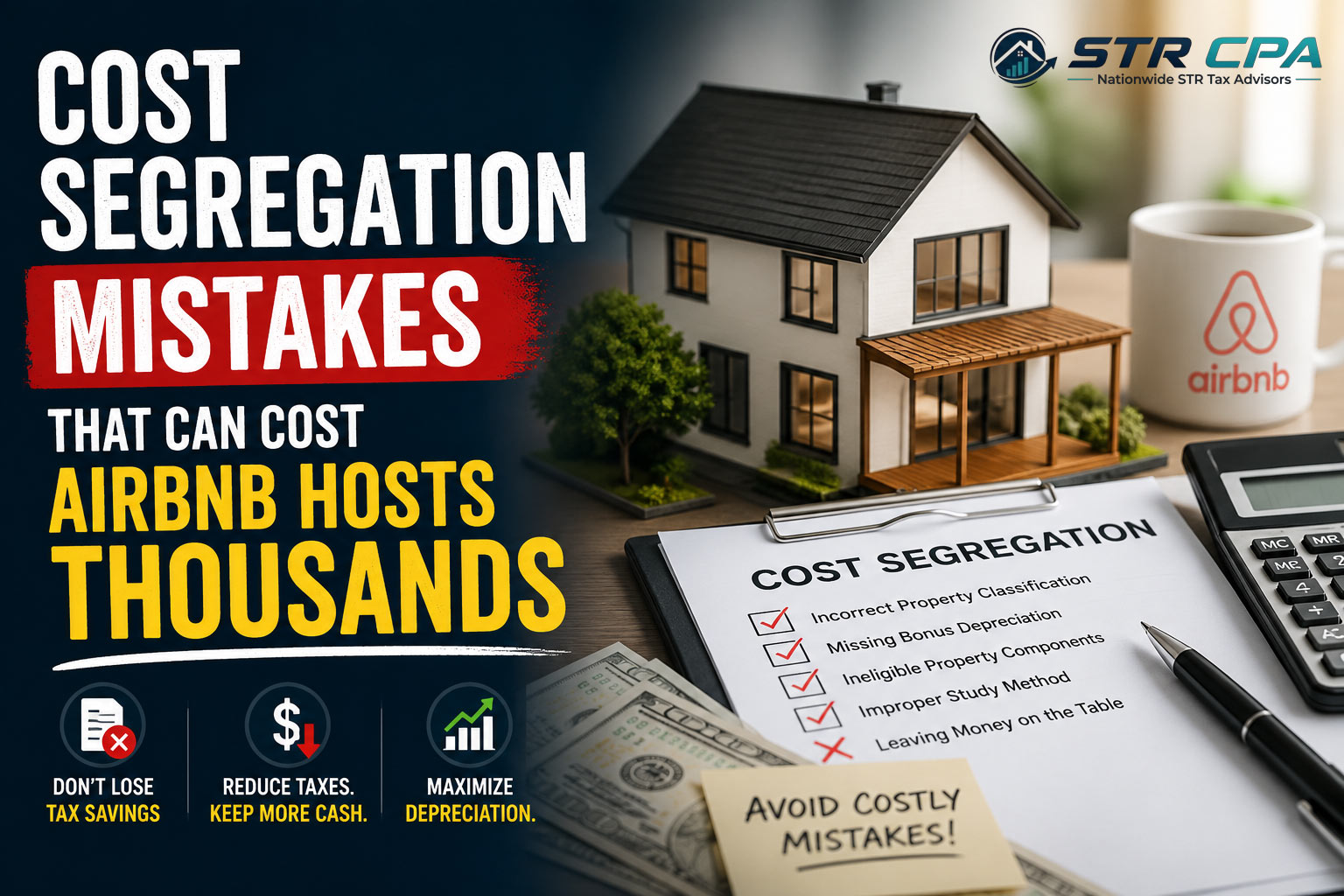
Cost Segregation Mistakes That Can Cost Airbnb Hosts Thousands

Home / Blog / Cost Segregation Mistakes That Could Cost Airbnb Hosts Thousands (2026 Guide)

Date: July 23, 2026, Category: Blog, Cost Segregation Guide

Airbnb Tax Strategy Guide

Cost Segregation Mistakes Airbnb Hosts Should Avoid

Imagine purchasing a vacation rental worth nearly one million dollars, investing thousands more into renovations, furniture, outdoor amenities, and upgrades—only to discover years later that you missed one of the largest tax-saving opportunities available to real estate investors. That situation is far more common than most Airbnb hosts realize. Many investors hear about cost segregation through accountants, YouTube videos, social media, or other investors, but few truly understand how it works—or the expensive mistakes that can dramatically reduce its benefits. When implemented correctly, cost segregation can accelerate depreciation, improve annual cash flow, reduce taxable income, and support advanced tax strategies such as the Short-Term Rental Tax Loophole. However, when done incorrectly, it can result in missed deductions, IRS complications, unnecessary penalties, and thousands of dollars in avoidable taxes. In this comprehensive guide, you’ll learn exactly what cost segregation is, why Airbnb investors use it, how the process works, and the most common mistakes that prevent property owners from maximizing every available tax deduction.

What Is Cost Segregation?

Cost segregation is a specialized tax strategy that allows real estate owners to accelerate depreciation by separating specific building components into shorter IRS depreciation schedules. Instead of depreciating an entire residential rental property over 27.5 years, a professional engineering-based cost segregation study identifies assets that qualify for depreciation over 5, 7, or 15 years. These assets often include flooring, cabinetry, appliances, decorative lighting, furniture, landscaping, fencing, parking areas, patios, outdoor improvements, specialized electrical systems, and numerous other components that the IRS allows to be depreciated more quickly.

Why This Matters

Accelerated depreciation means larger deductions during the early years of property ownership. Rather than waiting nearly three decades to recover qualifying asset costs, investors may receive substantial tax deductions much sooner, improving liquidity and reducing annual tax liability.

Why Airbnb Investors Use Cost Segregation

Vacation rental properties typically contain significantly more personal property and land improvements than traditional long-term rentals. Fully furnished interiors, premium kitchens, entertainment systems, pools, outdoor kitchens, hot tubs, decks, landscaping, decorative lighting, and luxury amenities often create substantial opportunities for accelerated depreciation. Because Airbnb properties generate business income through active guest operations, many investors actively seek ways to maximize deductions while improving annual cash flow. When paired with proper tax planning and professional guidance, cost segregation can become one of the most valuable financial strategies available to qualifying vacation rental owners.
 

Reduce Current Taxes

Increase depreciation deductions that may significantly lower taxable income during the early years of ownership.


Improve Cash Flow

Keeping more cash today allows investors to renovate properties, build reserves, or purchase additional vacation rentals.


Scale Faster

Tax savings generated through cost segregation often become additional capital for expanding a real estate portfolio.

How Cost Segregation Actually Works

Many Airbnb investors assume cost segregation simply means claiming more depreciation. In reality, the process is considerably more sophisticated. A professional engineering-based study analyzes the property in detail, identifies assets that qualify for accelerated depreciation, and prepares documentation that supports those classifications if questions ever arise.

Although every study is unique, the overall process generally follows the same sequence.

1

Purchase or Improve an Airbnb Property

The process begins after purchasing, constructing, or substantially renovating a vacation rental property. Newly acquired Airbnb properties often create the greatest opportunities because numerous building components may qualify for accelerated depreciation.

2

Engineering-Based Property Analysis

Specialists examine architectural drawings, construction documents, purchase records, renovation invoices, inspections, and property details to determine which assets qualify for shorter IRS depreciation lives.

3

Asset Classification

Rather than treating the building as one depreciable asset, engineers classify hundreds of individual components into appropriate IRS depreciation categories such as five-year, seven-year, fifteen-year, and twenty-seven-and-a-half-year property.

4

Prepare the Cost Segregation Report

The completed engineering report documents how every qualifying asset was identified and classified. This documentation becomes valuable support if questions arise during future IRS examinations.

5

CPA Implements the Tax Strategy

Your CPA incorporates the study into your depreciation schedules, coordinates bonus depreciation where applicable, and integrates the findings into your broader tax strategy to maximize legal deductions while maintaining compliance.

Key Takeaway

Cost segregation is not a tax loophole by itself—it is an IRS-recognized depreciation strategy. The greatest benefits come from proper planning, accurate engineering analysis, detailed documentation, and year-round CPA guidance. Investors who rush the process or rely on inexperienced providers often miss significant deductions or create expensive compliance issues, which is why understanding the common mistakes is just as important as understanding the strategy itself.

10 Cost Segregation Mistakes That Can Cost Airbnb Hosts Thousands

Cost segregation can generate significant tax savings when performed correctly, but small mistakes can reduce deductions, create IRS issues, or eliminate valuable tax benefits altogether. Before ordering a study, every Airbnb investor should understand these common mistakes and how to avoid them.

1. Ordering a Study for the Wrong Property

Not every vacation rental benefits from cost segregation. Smaller properties or low-value investments may not generate enough tax savings to justify the study. A CPA should first determine whether the projected savings outweigh the cost.

2. Waiting Too Long

Many investors postpone cost segregation for years, delaying depreciation benefits and reducing current cash flow. Although look-back studies are possible, implementing the strategy earlier generally provides greater financial advantages.

3. Hiring an Inexperienced Provider

Low-cost providers may rely on estimates instead of engineering-based analysis. Inaccurate asset classifications can increase IRS risk and reduce allowable deductions. Always choose qualified professionals with experience in cost segregation studies.

4. Assuming Everything Qualifies

Not every renovation, repair, or improvement qualifies for accelerated depreciation. Incorrectly classifying building components may require amended returns or adjustments during an IRS examination.

5. Ignoring Bonus Depreciation Changes

Bonus depreciation rules continue to change under federal tax law. Assuming prior-year percentages still apply may result in unrealistic tax projections. Always verify current regulations before making investment decisions.

6. Poor Bookkeeping

Missing invoices, renovation records, purchase agreements, and construction costs make it difficult to identify qualifying assets. Organized financial records improve the accuracy of every cost segregation study.

7. Focusing Only on Taxes

Cost segregation should support a broader investment strategy—not simply reduce one year’s tax bill. Cash flow, financing, future acquisitions, and exit planning should all be considered before implementing the strategy.

8. Not Coordinating with Your CPA

A cost segregation report alone does not create tax savings. Your CPA must properly integrate depreciation schedules, entity structure, passive activity rules, and other tax planning strategies into your return.

9. Overlooking State Tax Rules

Federal depreciation rules do not always match state tax treatment. Some states limit bonus depreciation or require separate calculations, making state-level planning equally important.

10. Treating Cost Segregation as a DIY Project

Online calculators and generic templates cannot replace an engineering-based study or professional tax advice. A properly documented study provides stronger IRS support while maximizing legitimate depreciation opportunities.

Expert Insight

The biggest mistake Airbnb investors make isn’t ordering a cost segregation study—it’s implementing one without a complete tax strategy. When combined with year-round CPA guidance, proper bookkeeping, entity planning, and current IRS compliance, cost segregation becomes a powerful wealth-building tool that can improve cash flow while supporting long-term portfolio growth.

Frequently Asked Questions (FAQs)

Is cost segregation worth it for every Airbnb property?

Not always. Larger properties, recently purchased homes, and rentals with significant improvements generally receive the greatest benefit. A CPA can estimate the potential tax savings before you invest in a study. 

Yes. In many cases, investors can perform a “look-back” cost segregation study and claim missed depreciation without amending prior tax returns, subject to current tax rules and proper filing procedures.

A properly prepared engineering-based study following IRS guidance is a recognized tax strategy. Good documentation and professional implementation help support your depreciation claims if questions arise.

Luxury vacation homes, cabins, beach houses, lakefront rentals, multi-unit properties, and recently renovated Airbnb investments often generate the largest depreciation opportunities because they typically contain numerous qualifying assets.

Absolutely. A CPA can determine whether the strategy aligns with your tax situation, explain how bonus depreciation and passive activity rules may apply, and coordinate the study with your overall investment and tax planning strategy.